
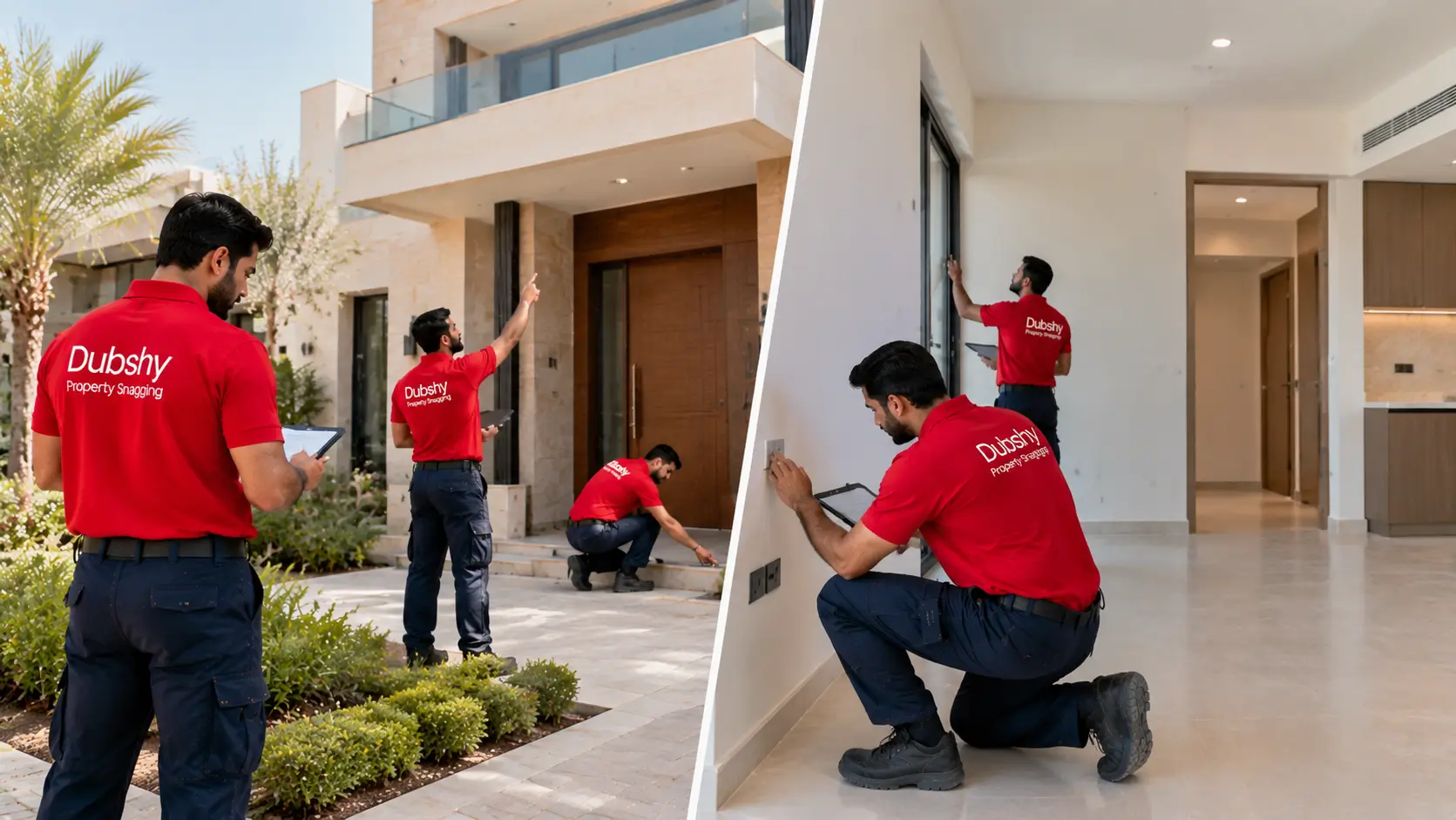
Villa vs Apartment Snagging Dubai: 2026 Comparison Guide
Villa vs apartment snagging in Dubai comes down to one core difference: a villa gives you an entire private structure to inspect, including the roof, garden, pool and external walls, while an apartment inspection focuses on a single sealed unit inside a shared building. That difference changes the cost, the checklist, the time on site and even which defects show up most often.
- Apartment cost
- AED 1,500–3,500
- Villa cost
- AED 3,500–8,000+
- Apartment time on site
- 2–4 hours
- Villa time on site
- 4–8 hours
- Average defects found
- 25–35 (apartment) vs 35–45+ (villa)
- Defect Liability Period
- 12 months for both
If you are weighing a villa purchase against an apartment purchase, or you already own one and are booking your handover inspection, this guide lays out every meaningful difference between the two.
What Are the Core Differences Between Villa and Apartment Snagging?
Snagging, also called a defect inspection or snag list, is the process of documenting construction flaws and unfinished work before you formally accept a new property from the developer. The objective is identical for both property types: protect your right to free rectification during the Defect Liability Period. The execution, however, is not.
| Factor | Apartment snagging | Villa snagging |
|---|---|---|
| Inspection scope | Single indoor unit | Full standalone structure: indoor, outdoor, roof |
| Typical cost | AED 1,500–3,500 | AED 3,500–8,000+ |
| Time on site | 2–4 hours | 4–8 hours |
| External elements | None (building management's responsibility) | Roof, garden, pool, driveway, boundary walls |
| MEP complexity | Shared building systems plus unit-level MEP | Independent, standalone MEP for the entire property |
| Average defects found | 25–35 per unit | 35–45+ per unit |
| Common defect focus | Finishes, sockets, AC, plumbing fixtures | All of the above, plus roofing, landscaping, pool plant, structural cracks |
The one-sentence version: apartment snagging is deep but narrow, while villa snagging is broad and deep, because a villa owner is responsible for far more of the physical structure than an apartment owner is.
How Much Does Villa Snagging Cost Compared With Apartment Snagging?
Snagging companies in Dubai typically price using either a flat fee, which is common for standardized apartments, or a per-square-foot model, which is more common for larger and more complex villas.
| Property type | Typical cost (AED) | Pricing model |
|---|---|---|
| Studio / 1-bed apartment | 1,500–2,500 | Flat fee |
| 2–3 bed apartment | 2,000–3,500 | Flat fee |
| Townhouse | 2,500–5,000 | Flat fee or per sq ft |
| Standard villa | 3,500–6,000 | Per sq ft (BUA) common |
| Luxury villa | 5,000–8,000+ | Per sq ft (BUA) common |
| Per sq ft alternative | About AED 1 per sq ft of BUA + VAT | Used across all types |
Villas cost more to snag, and it is not just about size. A 4,000 sq ft villa with multiple balconies, a private garden, a swimming pool and outbuildings has a genuinely larger inspection scope than a similarly sized apartment. The apartment sits inside a building where roofing, structure and common systems are the developer's or owners' association's responsibility, not yours.
Cost versus risk
Whether you are comparing villa or apartment snagging costs, the fee is small next to the cost of a single missed defect. A hidden plumbing leak or an unaddressed electrical fault can cost many times the inspection fee once it falls outside the Defect Liability Period.
What Gets Inspected in a Villa vs an Apartment?
The apartment checklist is the core of every snagging inspection in Dubai. Villa snagging extends that same core outward, onto the roof, into the garden and around the entire perimeter of the plot.
Apartment snagging checklist
- Walls, ceilings and floors. Cracks, uneven plaster and paint blemishes.
- Tiling. Tap test for hollow sounds, and check grout consistency.
- Doors and windows. Alignment, seals and smooth operation.
- Plumbing. Water pressure, drainage and under-sink leaks.
- Electrical. Every switch and socket tested, and the DB checked for open terminations.
- AC. Performance and airflow at each vent.
- Kitchen. Cabinetry and appliance function, if included.
- Balcony. Floor slope and railing security.
Villa snagging checklist
Everything in the apartment checklist, plus:
- Roof and terrace waterproofing. Check for ponding water and correct drainage fall.
- External walls. Cracks, and render and paint condition.
- Garden. Irrigation, landscaping drainage and outdoor lighting.
- Swimming pool, where applicable. Plant room, filtration and pool tiling.
- Driveway and boundary. Garage door and boundary wall or fencing condition.
- Roof water tank. Pressure is a frequent post-handover complaint in villas.
- Staircases. Handrail stability and tread evenness across multiple floors.
- Standalone MEP. Independent systems rather than shared building infrastructure.
Want an engineer to work through the full list?
book an inspectionWhich Defects Are Most Common in Villas vs Apartments?
Both property types share a common core of construction issues. Hollow or lippage-prone tiling, paint film defects, joinery alignment problems and MEP commissioning gaps are consistently among the most frequently reported items across every property type in Dubai. Where they diverge:
Apartments most commonly show
- MEP commissioning gaps concentrated in the unit itself.
- Waterproofing failures at wet-area transitions, such as bathrooms and kitchens.
- Finishes inconsistency across tiling, paint and joinery.
Villas most commonly show
- Water damage from rooftop leaks, one of the most frequently reported villa-specific issues.
- Structural cracking, given the larger and more exposed building envelope.
- Poorly laid garden tiling or landscaping drainage.
- HVAC zoning issues across multiple floors.
- Roof tank pressure imbalance.
Professional inspectors report that villa developments average 35–45 defects per unit, compared with 25–35 for apartment developments. That gap is driven almost entirely by the added outdoor and structural scope, not by worse workmanship.
How Do the Timeline and Process Differ?
| Stage | Apartment | Villa |
|---|---|---|
| On-site inspection time | 2–4 hours | 4–8 hours |
| Report turnaround | 24–48 hours | 48–72 hours (larger scope) |
| Ideal booking window | 14–30 days before handover signing | 14–30 days before handover signing |
| Re-inspection after fixes | Recommended | Strongly recommended (larger defect count) |
| 11th-month DLP check | Recommended | Strongly recommended |
The process itself is identical for both property types:
- Wait for the handover noticeThe developer's official notice starts the clock.
- Book inside the contractual windowThis is typically 14–30 days before signing.
- Confirm access and utilitiesUtilities must be live, with access to every room, cupboard and, for villas, every outdoor area.
- Walk the property systematicallyUse the relevant checklist above.
- Document every defectRecord photos, location tape and a severity rating: Critical, Major or Minor.
- Submit the snag report in writingAsk the developer for a rectification timeline.
- Re-inspect and follow upRe-check once repairs are complete, then schedule a follow-up around month 10–11.
Should You Snag Yourself or Hire a Professional?
| Factor | DIY | Professional |
|---|---|---|
| Cost | Free | AED 1,500–3,500 (apartment) / AED 3,500–8,000+ (villa) |
| Hidden defect detection | Visual only | Moisture meters, thermal imaging, electrical testers |
| Best for apartments | Confident buyers with time to spare | Overseas investors, first-time buyers |
| Best for villas | Rarely sufficient alone, given the scope | Strongly recommended: roof, pool and structural checks need specialist tools |
A DIY walkthrough is more viable for an apartment, where the scope is contained and largely visible. For a villa, the added roof, structural and outdoor scope makes a professional inspection considerably more valuable. A rooftop leak or a hairline structural crack is exactly the kind of defect a DIY walkthrough is most likely to miss.
What Are Your Legal Rights Under RERA, DLD and the Defect Liability Period?
Whether you are comparing villa vs apartment snagging in Dubai, the legal protections are identical.
- Defect Liability Period (DLP). Developers must rectify mechanical, finishing and fixture defects (plumbing, electrical, HVAC, paint, tiling, doors, windows) for 12 months after handover, for both villas and apartments.
- Structural defects. Covered for 10 years after handover under UAE law, including foundations, load-bearing walls and structural waterproofing.
- RERA. Provides a formal complaint channel if a developer refuses to fix a documented, legitimate defect.
- Dubai Land Department (DLD). Oversees registration and handover compliance for all residential property types.
- Your leverage window. The contractual snagging window, typically 14 to 30 days before handover signing, is when the developer's rectification obligation is strongest, since final payment is often still outstanding.
Never sign before inspecting
Signing the handover certificate confirms you accept the property in its current condition. It weakens your negotiating position substantially, even though the 12-month DLP still applies afterward. For official information, see the Dubai Land Department.
What Are the Pros and Cons of Snagging Each Property Type?
What Are the Most Common Snagging Mistakes?
- Signing before inspecting. This is the most damaging mistake on either property type.
- Underestimating the time. A rushed 30-minute walkthrough will miss far more on a villa than on an apartment, simply due to scope.
- Assuming someone else checks the building envelope. That is true for the shared structure, but not for anything inside your unit's walls.
- Skipping the roof and garden on a villa. They are easy to overlook next to interior finishes, yet consistently among the highest-value areas to inspect.
- Not testing every switch, socket and tap. Partial testing is how faults go unnoticed for months.
- Forgetting the 11th-month inspection. Many defects, such as AC commissioning gaps and hidden leaks, only surface after real usage.
How Do You Choose a Snagging Company?
Whether you are booking a villa or apartment inspection, the same credentials matter:
- Licensing. DED-licensed and RERA-aware.
- Certified inspectors. Ideally with recognized accreditation such as InterNACHI.
- Proper equipment as standard. Thermal imaging, moisture meters, laser levels and electrical testers.
- A sample report. Available before booking.
- Re-inspection. Included or clearly priced.
Red flag, and one extra check for villas
A quote dramatically below the market range for either property type usually signals a rushed inspection. For villas, confirm the quote explicitly includes the roof, pool plant (if applicable) and garden. Some providers price a "standard" inspection that quietly excludes outdoor scope unless you ask.
FAQs
Is villa snagging more expensive than apartment snagging in Dubai?
Yes. Villa snagging typically costs AED 3,500–8,000+, compared with AED 1,500–3,500 for apartment snagging. The difference reflects the larger inspection scope, because villas add roofing, garden, pool and independent MEP systems that apartments don't require.
How long does villa snagging take compared to apartment snagging?
A villa snagging inspection typically takes 4–8 hours, roughly double the 2–4 hours needed for a comparable apartment, because of the added outdoor and structural scope.
Do villas and apartments have the same Defect Liability Period?
Yes. Both carry a 12-month Defect Liability Period for mechanical and finishing defects, and a 10-year period for structural defects, under the same UAE legal framework.
What defects are most common in villas vs apartments?
Apartments most commonly show MEP commissioning gaps and wet-area waterproofing issues concentrated within the unit. Villas add rooftop water damage, structural cracking, garden drainage problems and roof tank pressure imbalance, on top of the same core issues apartments face.
Can I do villa snagging myself, or do I need a professional?
A DIY walkthrough can catch visible issues in either property type, but villas benefit more from professional tools. Thermal imaging and moisture meters are particularly valuable for catching rooftop leaks and hidden structural moisture that a visual-only inspection would miss.
Which property type has more snagging issues on average?
Villas average more total defects per unit, typically 35–45 versus 25–35 for apartments. This reflects the larger inspection scope rather than worse construction quality.
Should I snag a townhouse using the villa checklist or the apartment checklist?
Neither alone. A townhouse sits between the two. It shares a party wall like an apartment building's shared structure, but includes a private roof, garden and garage like a villa, so it needs elements of both checklists.
When should I book snagging for a villa or apartment?
For both property types, book inside the contractual snagging window, typically 14–30 days before your scheduled handover signing, when developer rectification leverage is strongest.
Does a bigger villa always mean a higher snagging cost than a smaller apartment?
Generally yes, but complexity matters as much as size. A villa with a pool, multiple balconies and a private garden costs more to inspect than a similarly sized villa without those features, and can exceed the cost of a much larger apartment.
What happens if the developer refuses to fix a defect?
For both villas and apartments, buyers can file a formal complaint through RERA or the Dubai Land Department if a developer refuses to rectify a documented, legitimate defect within the Defect Liability Period.
Ready to Book Your Handover Inspection?
Villa vs apartment snagging is not a question of which is better. It is about matching the inspection to the scope of what you own. Share your handover date and property type, and we will plan the inspection before you sign.