
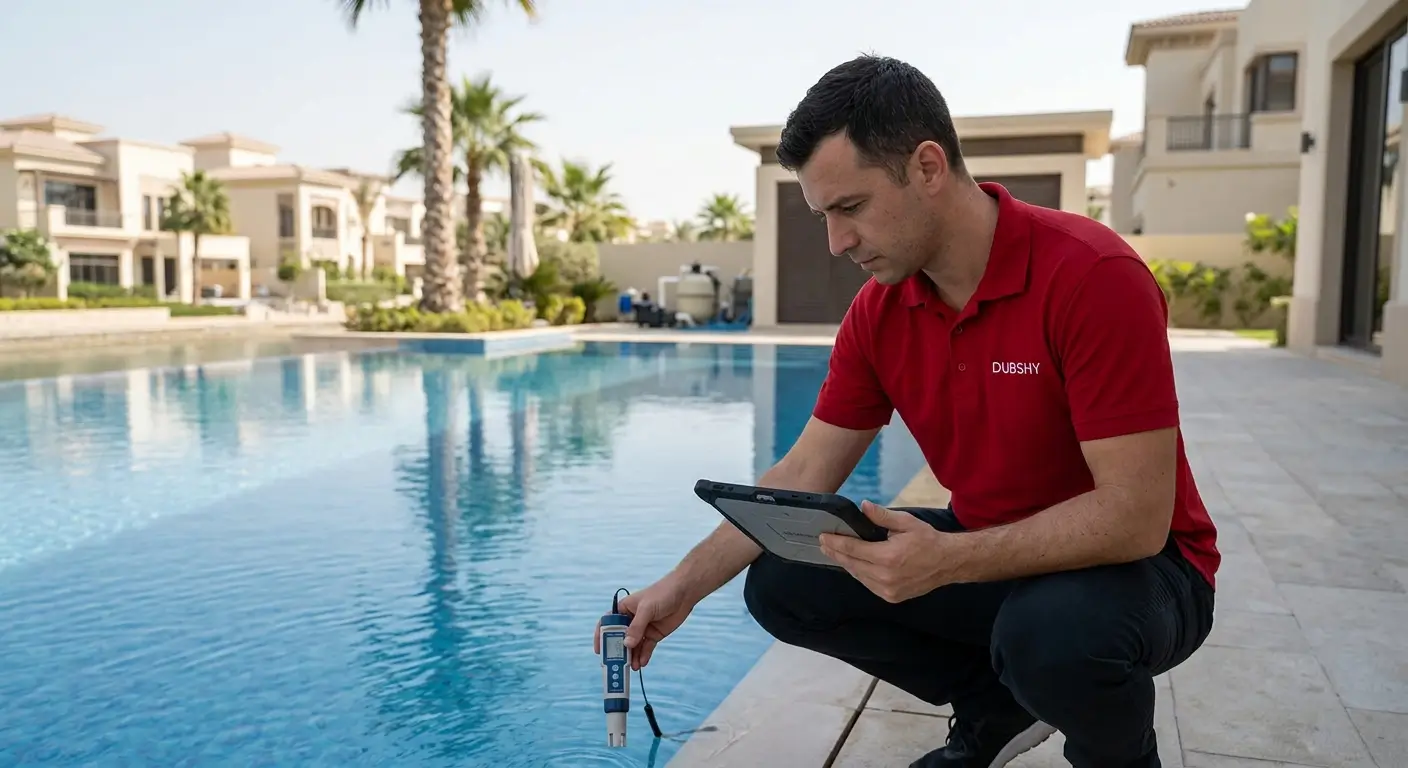
Pools get signed off with barely a glance. The water’s in, the lights work, it looks like a pool. Everyone moves on to the kitchen.
Then twelve months later the level keeps dropping, the pump is short cycling, and a tile has lifted at the waterline. By then the defects liability period has closed and a pool repair is one of the more expensive things you can be handed.
A Swimming Pool Inspection Dubai Villa owners book at handover covers the shell, the surrounds, the plant and the electrical safety. It’s the amenity most often skipped and the one where skipping costs most.
What does a pool inspection cover?
Four areas: the shell and finishes, the surrounds and coping, the plant room and circulation system, and the electrical installation. Each fails in its own way, so a Swimming Pool Inspection Dubai Villa requires treating them as four separate surveys rather than one walk around the water.
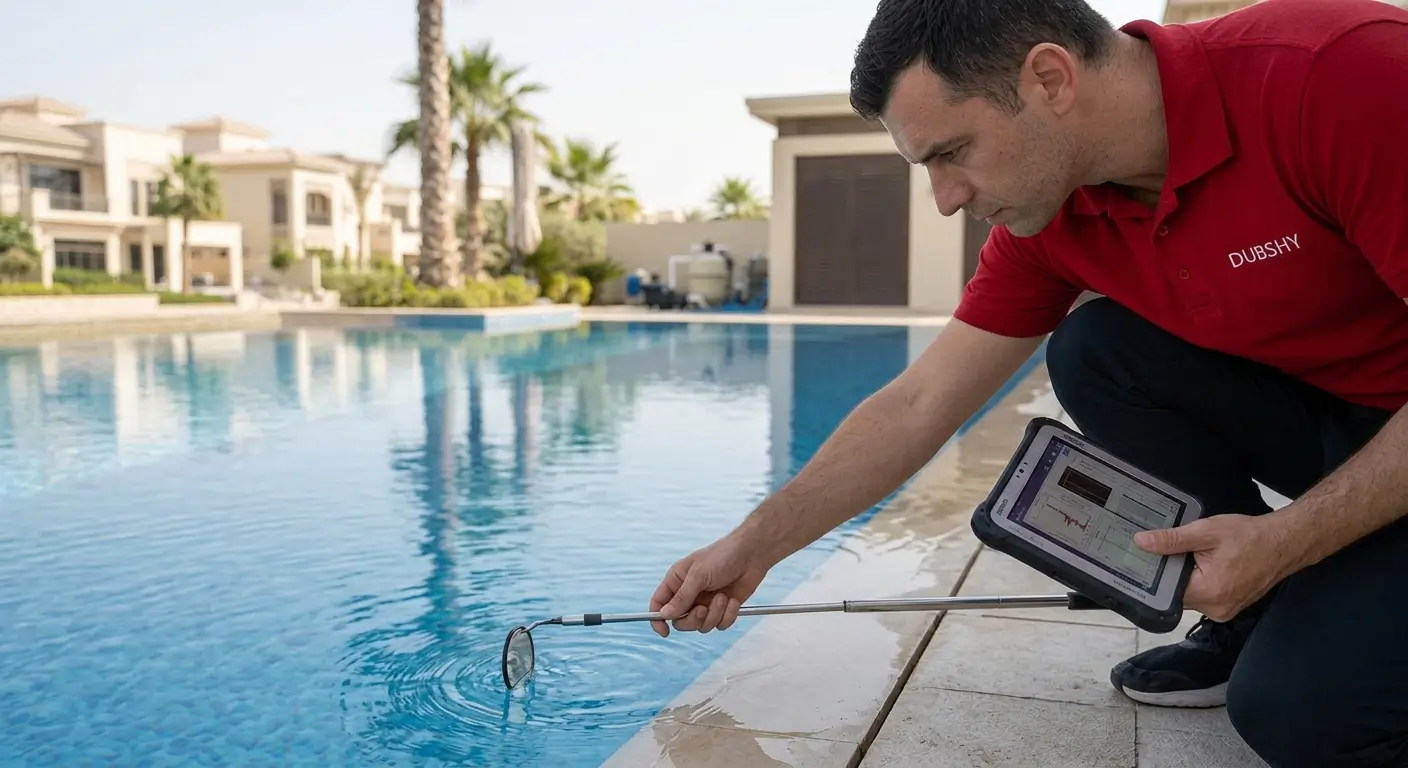
The shell and waterline
Check the tiling for lippage, loose bedding, and any tile that sounds hollow when tapped. Waterline grout failure is common within the first year and much easier to raise while the developer is still liable. Look for hairline cracking in the shell, staining that suggests a chemical imbalance during commissioning, and any movement at the step or bench junctions.
Coping and surrounds
Coping stones should be level, firmly bedded and evenly jointed, with no rocking underfoot. The deck around the pool needs falls running away from the water toward drainage, not back into it. Where the surround meets the coping, the movement joint has to be present and correctly filled, because that’s where cracking starts when the slab moves in summer heat.
Plant room and circulation
Confirm the pump and filter are commissioned and running rather than simply installed. Check the skimmers draw properly at the correct water level, the balance tank fills and holds, valves are labelled, and pipework is supported and free of leaks at the unions. A plant room with no floor drain is a defect worth logging on its own.
Electrical safety
This is the part that matters most and gets checked least, because none of it is visible. Pool lighting needs the correct rating for immersion, protected by an RCD that actually trips when tested. Equipotential bonding should connect the metal parts around the pool, including ladder handrails and any metalwork in the deck. Every socket in the pool area needs a proper weatherproof enclosure.
How do you test a pool for leaks?
With a bucket test, which separates evaporation from an actual leak and costs nothing to run. Dubai loses a lot of water to evaporation in summer, so a dropping level on its own proves nothing.
- Fill a bucket. Place a weighted bucket on a step, filled with pool water to roughly the same level as the pool itself.
- Mark both levels. Mark the water level inside the bucket and outside it on the pool wall.
- Leave the pump running normally. Run the pool as usual for 24 hours with no swimming and no topping up.
- Compare the drop. If both levels dropped equally, that’s evaporation. If the pool dropped more than the bucket, there’s a leak.
- Repeat with the pump off. A larger loss with the pump running points to the circulation pipework rather than the shell.
What if the pool isn’t finished at handover?
Record it as an outstanding item rather than a defect, in writing, with the date. Incomplete works and defective works follow different routes, and a pool signed off as complete when it isn’t becomes much harder to challenge later.
Take photographs of the state it’s in, note what’s missing, and ask for a completion date in writing. Our external work checks cover the pool alongside the roof, driveway, boundary and plot drainage, since those items tend to be handed over in a similar state of not-quite-finished.
What about the pool barrier and safety features?
Check whatever safety provision was part of your handover scope, because this is one area where an omission is a genuine risk rather than an inconvenience. Fencing, self-closing gates, alarms and covers all vary by community and by what was specified in your agreement.
Where a barrier was included, check the gate self-closes and self-latches from any position, the latch sits high enough to be out of a child’s reach, and there’s nothing adjacent that could be climbed. Where nothing was specified, that’s worth knowing now rather than assuming otherwise.
Community rules matter here too. Some Dubai communities set their own requirements for private pools, and it’s easier to comply at handover than to retrofit later.
What ongoing costs should you expect?
A private villa pool in Dubai carries running costs most first-time owners underestimate: electricity for the pump, water to replace evaporation losses through summer, chemicals, and either your own time or a monthly maintenance contract.
That matters at handover because a badly commissioned pool costs more to run for its entire life. An undersized or incorrectly set pump runs longer to turn the water over. A skimmer set at the wrong level pulls air and makes the pump work harder. Both are correctable defects on day one and permanent expenses if nobody raises them.
Why do pool defects get missed?
Because the pool is usually full of water on handover day, and water hides almost everything. A filled pool conceals shell cracking, tile bedding, step junctions and outlet condition.
The plant room gets skipped for a different reason. It’s a hot cupboard full of pipework at the side of the plot, and nobody wants to spend twenty minutes in it during their handover slot. That’s where the commissioning failures live.
The electrical checks get skipped because they need testing equipment. You can’t see whether an RCD trips or whether bonding is connected. You have to test it, and that’s the part a walkthrough can never cover.
What should you get in writing at pool handover?
Ask for the commissioning records, the equipment documentation and the maintenance schedule, because all three are difficult to obtain later and all three matter.
- Pump and filter make, model and commissioning date
- Recommended run times and turnover rate for the pool volume
- Chemical dosing set-up used at commissioning
- Warranty documents for pump, filter, heater and lighting
- Location and function of every valve in the plant room
That last one sounds trivial until you’re standing in a plant room during a leak with six unlabelled valves and no idea which one isolates what.
Frequently asked questions
What does a swimming pool inspection include?
A Swimming Pool Inspection Dubai Villa need covers shell and waterline tiling, coping and deck levels, skimmers and balance tank, pump and filtration commissioning, pipework and valves, pool lighting rating, RCD function and equipotential bonding, plus a leak test.
How do I know if my pool is leaking or just evaporating?
Run a bucket test. Place a bucket of pool water on a step, mark the level inside and outside, and compare the drop after 24 hours. Equal loss means evaporation, while a greater loss in the pool means a leak.
Is a villa pool covered under the defects liability period?
Yes, where it formed part of the handover scope. Shell defects, tiling failures, uncommissioned plant and electrical faults all fall inside the one-year period in most villa handovers.
How much water should a Dubai pool lose to evaporation?
Losses vary significantly with season, wind and whether a cover is used, so the useful measure is comparative rather than absolute. That’s exactly why the bucket test exists.
Do I need the pool empty for an inspection?
Not usually. A full pool limits what can be seen of the shell and step junctions, but coping, plant, electrical safety and leak testing are all assessed with water in. Draining is only needed where a shell defect is suspected.
What are the biggest pool safety issues at handover?
Pool lighting without proper RCD protection, missing equipotential bonding to metalwork, and unprotected sockets in the pool area. All three are testable and all three are straightforward for a developer to correct.
Can a pool be inspected in summer?
Yes, and summer is arguably better for leak testing because evaporation rates are highest, which makes the bucket test comparison more informative. Plant room checks are simply less pleasant in August.
When should I book the inspection?
Book a swimming pool inspection Dubai side alongside your villa handover survey, then again before the defects liability period expires. Defects such as tile bedding failure and shell movement often become visible only after a full season of use.
Don’t sign off the pool on sight
A pool that looks finished and a pool that’s been commissioned properly are two different things, and only one of them is testable. A Swimming Pool Inspection Dubai Villa book at handover catches the plant and electrical faults that a full pool hides completely. That’s why we treat it as its own section of the report at Dubshy.
If your villa handover includes a pool, book a villa inspection and we’ll test the plant, the bonding and the shell before you accept it.